Wednesday, June 19, 2013

Storify & Telling a Story Using Social Media


George's post has me searching for Storify items as I have never used it before, but am incredibly intrigued.

The idea is that students can research on the web for information that is found on social media and then create a story.  Video, G+, Twitter, Facebook and several other media can be used.  You can also add in titles and comments and easily manipulate the order.  Here is a written document for how to use it and above is a short video explaining the same.

Below is an example of Storify for the life of Rosa Parks. 

Tuesday, June 18, 2013

More on Twitter: Educators Discuss its Value

Jerry Bluemengarten and Sean Junkins, a technologist in the Myrtle Beach, SC schools discuss the value of Twitter in the slideshow below. (I collected the tweets into a program called Storify and saved it as a slide show.)

Monday, June 17, 2013

Using Voice Comments with Google Docs

If you collect assignments through Google docs, you can grade and comment on on those assignments with voice comments. Tucker English walks you through the process here at TeacherCast.   The process is simple. I tried it it and it works well. When you open a Google document, click connect to more apps, just like the photo in the article. Then, every time you open a document, you just click open with "voice commands."

Saturday, June 15, 2013

History of the Am Revolution in Five Minutes


The title pretty much says it all if you want a quick overview of the American Revolution. 

Rubrics for Every Assignment

One of the questions I get (and I get a lot of them) is how do you grade online assignments.  My short answer is that I like rubrics, but there are as many rubrics as there are assignments.  So one of the webpages I like is Ribistar which has improved a lot since I wrote about it three years ago.  Now you simply use the drop down menu to answer some questions about your assignment and just like that you have a rubric.  Give it a try. 

Wednesday, June 12, 2013

MOOC Summer Courses

With summer approaching very quickly (yes I still have students until June 18th!), there may be time for you to recharge and try something else.  One thing you might want to do is to take free courses online called a Massive Open Online Courses (MOOC).  Here is the complete list and here are the ones for the humanities. 

Kennedy’s Finest Moment

A day after George Wallace took his infamous stand against segregation at the University of Alabama, a white segregationist murdered the civil rights leader, Medgar Evers. In the span of two days, the civil rights movement became a national crisis. President Kennedy responded in what Peniel E. Joseph, a Tufts University professor and founding director of the Center for the Study of Race and Democracy  calls his finest moment.

He went on national television not just to report the revolution but, writes Joseph in this editorial for the New York Times , "invited Americans of all backgrounds to engage in the kind of civic activism that reflects the tough work of democracy. 'A great change is at hand, and our task, our obligation, is to make that revolution, that change, peaceful and constructive for all.'”

Joseph argues that Kennedy defined the crisis for Americans and even presidents following Kennedy. Students studying the civil rights movement and President Kennedy might find this story compelling.

Monday, June 10, 2013

Hip Hughes Videos on US History


Hip Hughes has a series of clips about American History from the Emancipation Proclamation above, to the Articles of Confederation, the New Deal, Colonialism, and the Industrial  Revolution, to name a few.  You can find the whole series here.

Friday, June 7, 2013

Four Cool IPad Apps

Sean Junkins, in this Google hangout web cast from Edudemic, reviews four I-Pad apps that are great for content creation. Junkins is a learning specialist in the Myrtle beach, SC school district. He reviews Splice (movie making app), Poplet, (timeline among other things), Haiku Deck (a little like PowerPoint), and Morfu (create famous figures and have them talk).

Wednesday, June 5, 2013

7 TEDTalks for U.S. History Classroom

Angela Hamblen Cunningham, a Kentucky teacher, put together on her blog these 7 TEDTalks for US History. Other clips, in addition to the Doris Kearns Goodwin clip above include:

David Hoffman's, Sputnik Mania, is particularly good. Cunningham also put together TEDtalks for World history and government. You can find her on Twitter at @kyteacher.

Tuesday, June 4, 2013

Easily Make MC Tests in Google Forms

We have a test maker for which we have to cut and paste each part of multiple choice questions into the "a" section and the "b" one, etc.  Well here is a much faster way for you to make convert your multiple choice questions to Google Form tests so students can take them online.  It is as easy as pasting the entire answer into the "a" slot in Google Form (as you can see above).  So very quickly you can make an exit ticket or even and entire test. I found the tip from the Google+ group Google in Education

Saturday, June 1, 2013

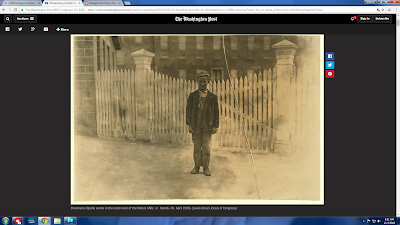
The Price of Rebellion in Jim Crow South

This is an exceptionally moving story about Jim Crow south that students might enjoy during coverage of the 60's.  Thanks to my colleague, Jeff Feinstein for sending me the link.

By 1963, Danville, Va., last capital of the Confederacy and where Jefferson Davis met his cabinet after fleeing Richmond, became a Jim Crow town.  Schools remained segregated nine years after the Supreme Court ordered them desegregated. Police put down black protest with particular brutality. 

Tess Taylor, in a article for the New York Times, explains how her grandfather, a mill worker, downed some bourbon and fired off a letter to the judge who had sentenced over 300 protesters, who had been badly beaten to fines and hard labor. She recounts how her grandfather, with four children to raise, apologized to the judge.  But that did little good. He never got a promotion from the mill in which he worked all his life.  Ms. Taylor does not see her grandfather as a hero.  She says: "when we look back on our troubled histories, especially at the distance of 50 years, we might like to imagine that we would be Skeeter Phelan, the character in “The Help,” or an abolitionist. My grandfather’s story recalls the painful complexity of oppressive regimes not only to those they oppress most directly but to anyone who dares to question them at all."

Friday, May 31, 2013

Using YouTube in Your Classroom

I found this great slide show on Crash Course for Educators which I found from one of the communities I follow on Google+.  Soon I will do a post on all the amazing new teacher and technology posts you can follow as they are growing quickly.  The video above is ten ways you can use YouTube to improve your classroom from ways to have stations, to flipping your class, to posting message to students and parents and more.

Monthly Most Hist Posts for the US History Teachers' Blog


Thanks to all of the new visitors to the three blogs (USworld and government) as we now have a new monthly record of 65,000 page views.  The most hit for the US history teachers' blog are:

Thursday, May 30, 2013

Digital (US) History - Free Textbook & Resources

The Digital History page is awesome and proof that you can sometimes get away with even purchasing a history textbook if you are willing to do a little leg work.  Look above at the richness of the choices from a textbook which you can see above from the blue links to primary documents, events, people, multimedia and so much more.   This site has really improved in the last few years since it first appeared.  Also for those of you who might be preparing your students for a state end of the year test, you could easily use this resource to differentiate the learning amongst your students.